Fluency Is Freedom: The Science Behind Math Confidence
Why We Need to Stop Fearing Math Drills
and Embrace Automaticity
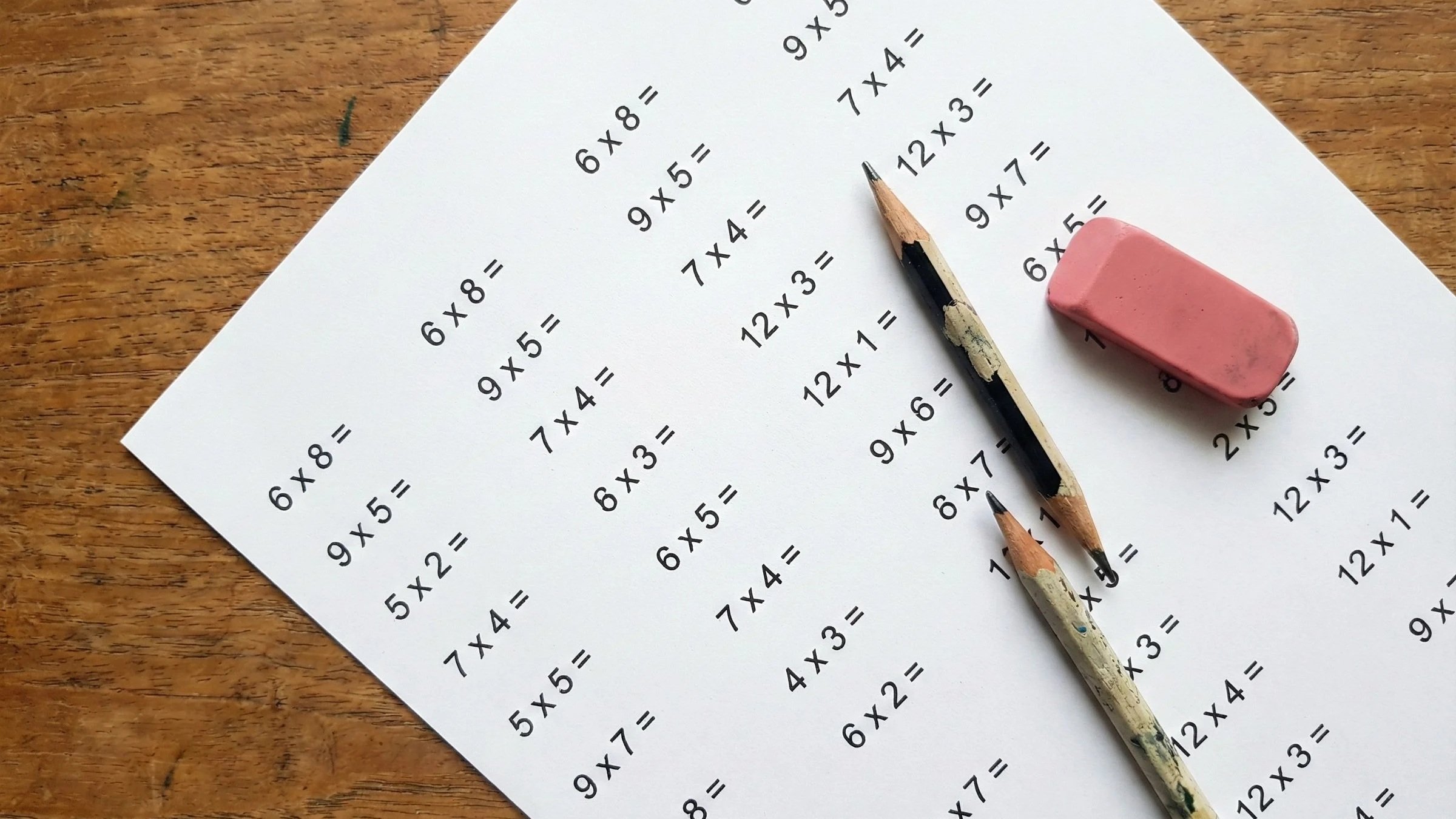
If I whisper the phrase “timed multiplication test” to a room full of adults, half of them will instinctively shudder.
It conjures memories of sweaty palms, a ticking kitchen timer, the frantic scratching of pencils, and the humiliating public posting of scores on a star chart. For a generation of students, math speed drills were the defining moment where they decided they were “not a math person.”
In response to this collective trauma, the pendulum of modern education swung hard in the other direction. Over the last twenty-five years, many school districts have quietly phased out or actively discouraged timed drills. The focus shifted entirely to “conceptual understanding”—the why behind the math. The argument was noble: we want students to be deep thinkers, not mindless calculators. We were told that in the age of smartphones, memorizing that 8 × 7 = 56 was obsolete.
As an educator, I first discovered the true value of timed math drills decades ago when I took over a mid-year Algebra I class at the Fairfax Christian School, an international university-prep school just outside Washington, D.C. With roughly a third of the roster failing, I gathered those struggling students into a dedicated section and began with basic assessment testing. The root cause of their trouble in Algebra immediately became obvious: rather than recalling math facts from memory, they were counting on their fingers or, worse, resorting to random guesses. Although they had transferred into our program with decent transcripts, it was clear that significant gaps in their foundational arithmetic skills were holding them back.
Immediately, I retrieved the speed drills from our kindergarten math book. And yes, we did start with 0 + 0 = 0. But within weeks of opening math class each day with a one-hundred-problem, one-minute speed drill, my “not a math person” class was excelling with confidence.
Removing Speed Drills Is a Mistake
While Fairfax Christian School has continued to use math drills, students transferring into our program have not had math speed drills and are often overwhelmed by basic arithmetic. The most effective way to get students back on track is to use math speed drills to improve arithmetic fluency, even at the high school level.
Removing math speed drills was intended to reduce anxiety and promote deeper learning, but abandoning speed drills has inadvertently created a crisis of cognitive overload. Many educators threw the baby out with the bathwater, failing to distinguish between stressful “drill and kill” tactics and the vital cognitive necessity of fluency. As Daniel Willingham argued in his influential work Why Don’t Students Like School? (2009), the mind is not designed to think—it is designed to save us from thinking. The brain prefers to rely on memory whenever possible, and education must work with this architecture, not against it.
It is time to rehabilitate the image of the math drill. When executed correctly, speed drills are not about torture; they are the essential gateway to higher-level mathematical thinking. They are the tools we use to build the brain’s infrastructure.
Here is the definitive argument for why speed still matters in mathematics, backed not by nostalgia, but by cognitive science.
The Cognitive Bottleneck:
Understanding Your Brain’s RAM
To understand why speed drills are crucial, we have to stop thinking about math as a “subject” and start thinking about the human brain as a computer.
Cognitive Load Theory (CLT), first developed by John Sweller at the University of New South Wales in 1988, is perhaps an essential principle for educators to understand. Sweller’s foundational paper, “Cognitive Load During Problem Solving: Effects on Learning” (1988), published in Cognitive Science, demonstrated that instructional design must account for the severe limitations of human cognitive architecture. In simple terms, your brain has two types of memory relevant here:
Working Memory. This is your brain’s “scratchpad” or RAM. It is where you consciously process new information. It is incredibly powerful but severely limited. George Miller’s seminal 1956 paper “The Magical Number Seven, Plus or Minus Two” first established the boundaries of this system, but subsequent research by Nelson Cowan (2001) has refined this estimate downward. The average human can only hold about three to five “chunks” of information in working memory at one time—fewer than we once thought.
Long-Term Memory. This is your brain’s hard drive. Its capacity is effectively infinite compared to short-term memory. Sweller and his colleagues later reframed long-term memory not merely as a storage bin, but as the central structure of human cognitive architecture. In their 2011 paper “An Evolutionary Upgrade of Cognitive Load Theory,” Sweller, Ayres, and Kalyuga argued that long-term memory is what makes complex thought possible—it organizes knowledge into schemas, large structured units that can be retrieved and deployed as single chunks in working memory.
Every time a student encounters a complex math problem—say, multiplying fractions or solving an algebraic equation—their working memory is flooded with demands. They have to understand the context of the problem, decide on a strategy, execute the steps in order, and monitor their own work for errors. Sweller called this the intrinsic cognitive load of the task—the inherent complexity of the material. When basic arithmetic facts are not yet stored in long-term memory, they add a layer of extraneous cognitive load—unnecessary processing that competes for the same limited resources.
If a student does not know their basic arithmetic facts instantly, every single calculation becomes a new demand on that limited working memory.
An Example
Imagine a middle school student attempting to solve the equation 3x + 8 = 29.
The Fluent Student. This student looks at the problem. They instantly know they need to isolate x. They mentally subtract 8 from 29. Because they know 29 − 8 = 21 instantly, without counting on fingers, that step uses almost zero cognitive load. Their brain whispers “21.” Now they see 3x = 21. Again, because they know their times tables, they instantly recognize that x must be 7. The entire process took seconds, and their brain energy was focused entirely on the algebraic reasoning—what Sweller would call the germane cognitive load, the productive effort devoted to learning new schemas.
The Non-Fluent Student. This student knows they need to subtract 8. But to do 29 − 8, they have to pause. They might count backward on their fingers, or set up a vertical subtraction problem in the margin. This side-quest takes ten to fifteen seconds of intense focus. By the time they arrive at 21, their working memory has dumped the original goal of the problem. They look back at 3x + … something, and have to reorient themselves. What was I doing again? Now they face 21 ÷ 3. If they don’t know that fact instantly, they have to skip-count by 3s until they hit 21.
The non-fluent student isn’t struggling with algebra; they are struggling with arithmetic. But because their working memory is completely jammed with basic calculations, they have no cognitive bandwidth left to understand the actual concepts being taught. They aren’t “bad at math”; their brain is just buffering.
This phenomenon has been confirmed repeatedly in the research literature. In a landmark study, Ashcraft and Kirk (2001) demonstrated in the Journal of Experimental Psychology: General that math anxiety directly reduces working memory capacity, creating a vicious cycle: students who lack fluency experience anxiety, which further degrades their working memory, which makes even basic computation harder, which produces more anxiety. The authors described this as a “cognitive consequence” model of math anxiety—the emotional distress literally shrinks the cognitive workspace.
Speed drills are the tool that moves basic facts from the limited working memory into the infinite long-term memory, freeing up the brain’s RAM for actual thinking.
Rebranding Rote: The Power of Automaticity
Critics of drills often use the phrase “rote memorization” as an insult. It implies robotic, unintelligent learning. We need to replace that term with a far more accurate and scientifically grounded goal: automaticity.
Automaticity is the ability to perform a task without occupying the mind with the low-level details required. Gordon Logan’s Instance Theory of Automatization (1988), published in Psychological Review, provided the theoretical framework that still dominates the field. Logan argued that automaticity is achieved when the brain transitions from executing an algorithm (a step-by-step process) to directly retrieving a stored answer from memory. Each time a student correctly solves 7 × 8, the brain stores a memory trace of that event. After enough traces accumulate, the brain bypasses calculation entirely and simply retrieves the answer. The process becomes, in Logan’s terms, a “single-step, memory-based” operation.
Automaticity is what allows you to drive a car while having a conversation. You aren’t consciously thinking “engage left turn signal, check mirror, apply 20% pressure to brake pedal.” You just turn left.
We accept the need for automaticity in almost every other skilled pursuit, yet we somehow resist it in math. Consider the following analogies:
The Musician. A jazz pianist does not practice scales for hours because they intend to perform scales at a concert. They practice scales so that when they are improvising, their fingers automatically know where the keys are in every key signature. If they have to think about which note is sharp in the key of D major during a performance, the music stops.
The Athlete. A basketball player practices free throws thousands of times. They are drilling muscle memory so that in the high-pressure final seconds of a game, the mechanics of the shot are automatic, allowing them to focus on the game situation.
The Reader. This is the most direct analogy and is supported by a substantial body of research. LaBerge and Samuels’ (1974) theory of automatic information processing in reading, published in Cognitive Psychology, established that fluent reading requires the automatic decoding of letter patterns.
Phonics are the “drills” of reading. We teach children to instantly recognize the sounds that letters make. If a fifth grader still has to painstakingly sound out every third word in a novel, they cannot possibly comprehend the themes, character development, or plot. Their brain is too busy decoding to actually read. The National Reading Panel’s landmark 2000 report confirmed that systematic phonics instruction produced significant benefits, and that fluency—defined as accurate, automatic word recognition—was a critical bridge between decoding and comprehension.
The Anxiety Paradox: Why Slowness Is Stressful
The loudest argument against speed drills is that they cause anxiety. Many people have math anxiety related to timed tests. But we must ask a critical question: does the timer cause the anxiety, or does the lack of knowledge cause the anxiety, which the timer merely reveals?
The research suggests the latter is far more common. Gersten, Jordan, and Flojo (2005), in their review for the Journal of Learning Disabilities, found that a lack of arithmetic fluency in early grades was one of the strongest predictors of later mathematical difficulty and associated anxiety. The anxiety, in other words, was downstream of the fluency deficit—not downstream of the drill.
For a student who does not know their multiplication tables, a timed test is indeed a humiliating, stressful experience. But removing the timer doesn’t fix the underlying issue; it just hides it. That same student will still feel intense anxiety when they are called on in class, or when they sit down to do homework and realize it will take them two hours to complete what their peers finish in twenty minutes.
Ramirez, Gunderson, Levine, and Beilock (2013) published a revealing study in the Journal of Experimental Child Psychology demonstrating that children with high working memory were more susceptible to the negative effects of math anxiety—precisely the students who should have been thriving. The implication is striking: anxiety doesn’t just affect “weak” students. It actively undermines the cognitive resources of the strongest students, making fluency-building all the more urgent for everyone.
The chronic, low-level anxiety of constantly feeling “behind” and “slow” is far more damaging in the long run than the acute stress of a one-minute drill.
Conversely, competence breeds confidence. There is a profound shift that happens when a child realizes they can look at a sheet of numbers and simply know the answers. It is empowering. Bandura’s (1977) self-efficacy theory holds that an individual’s belief in their capability to execute a task is the single strongest predictor of their willingness to engage with it. Mastery experiences, the kind that come from successfully completing increasingly challenging drills, are the most potent source of self-efficacy.
When a student achieves automaticity, math changes from a series of terrifying hurdles into a puzzle they have the tools to solve. Speed drills, when managed correctly, are actually an antidote to anxiety because they build the fundamental competence that makes math feel approachable.
Pattern Recognition and Number Sense
Beyond freeing up working memory, speed drills—particularly those focused on multiplication and division—help the brain begin to perceive numbers differently.
Stanislas Dehaene, the French cognitive neuroscientist and author of The Number Sense: How the Mind Creates Mathematics (1997, revised 2011), has spent decades mapping the brain’s numerical architecture using neuroimaging. Dehaene’s research reveals that the human brain is equipped with an approximate number system located in the intraparietal sulcus, but that exact arithmetic—the kind required for algebraic manipulation, fraction simplification, and so on—depends heavily on verbal and symbolic representations stored through practice and repetition.
When you drill times tables, you aren’t just memorizing isolated data points. Your brain, being a brilliant pattern-recognition machine, starts to map connections. A student who has drilled their twelve times tables begins to see the number 72 not merely as a random quantity but as a nexus point. They instantly see it as 8 × 9, as 12 × 6, and as half of 144.
This instant recognition allows for mental “shortcuts.” They realize that multiplying something by 4 is just doubling it twice. They intuitively grasp that multiples of 5 must end in 0 or 5. What emerges is what researchers call number sense—the intuitive feel for how numbers interact.
Berch (2005), in a comprehensive review in the journal Psychology, Science, and Education, catalogued over thirty distinct components of number sense identified in the research literature and found that many core components depended, to some extent, on rapid retrieval of basic arithmetic facts. You cannot deeply grasp the concepts of factors, primes, divisibility, and fraction simplification if you do not have immediate recall of multiplicative relationships. Speed drills are resistance-training exercises that build the number-sense muscle.
Speed Drills with Confidence
At the Fairfax Christian School, we have long maintained a policy permitting students to retake tests. We believe that the materials we have selected for our curriculum are critical to learning and that a working knowledge of them is essential for long-term success. Modern science is now backing up our time-tested principle.
Barak Rosenshine’s “Principles of Instruction” (2012), published in American Educator, synthesized decades of research on effective teaching and found that the most successful teachers shared a common pattern: they presented material in small steps, provided extensive guided practice, checked for understanding frequently, and ensured a high success rate before moving forward. Speed drills, when properly situated within Rosenshine’s framework, are a natural extension of these evidence-based principles.
Here is how we use speed drills effectively:
1. Accuracy Is the Gatekeeper of Speed
You should never progress through the speed drills until accuracy is near 100%. Drilling wrong answers just makes you faster at getting things wrong. Speed is the final step of mastery, not the first. This principle aligns with Rosenshine's “80% success rate” threshold: students should correctly complete the vast majority of items during practice; otherwise, the task is too advanced. This is why I started my Algebra I students back to 0 + 0 = 0.
2. You are Your Only Competition
The only fair way to evaluate a student using speed drills is to compare their performance to their own past performance. The goal should be: Can you beat your score from yesterday? This turns the drill into a personal high-score chase that is motivating rather than demoralizing, or into competition against other students working at different levels.
This approach is deeply supported by Carol Dweck’s (2006) work on mindset. When progress is measured against oneself rather than against peers, students adopt a growth mindset orientation. Effort becomes the variable, not innate ability. The drill becomes evidence that practice produces improvement—a belief that is both healthy and empirically true.
3. Short Bursts of Spaced Repetition
The brain learns best in short, frequent intervals, not long, grueling sessions. Doing a speed drill four times a week is vastly superior to doing a thirty-minute session once a week.
This principle rests on one of the oldest and most robust findings in all of learning science: the spacing effect, first documented by Hermann Ebbinghaus in 1885 and replicated in hundreds of studies since. Cepeda, Pashler, Vul, Wixted, and Rohrer (2006) conducted a meta-analysis of 254 studies involving more than 14,000 observations and concluded that distributing practice over time consistently produced superior long-term retention compared to massed practice. Short bursts requiring intense focus strengthen neural pathways without causing fatigue or boredom.
4. Low Stakes
These drills should have minimal impacts a report card grade. They are practice, like batting cage sessions. You don’t get cut from the team for missing a ball in the cage; you just keep swinging until you make contact.
The distinction between formative and summative assessment is critical here. Black and Wiliam (1998), in their landmark review “Inside the Black Box,” demonstrated that formative assessment—low-stakes feedback used to guide learning—produced among the largest effect sizes ever reported in educational research. When drills are positioned as formative practice rather than evaluative tests, students engage more freely, take risks, and learn more efficiently.
5. The Pen-to-Paper Advantage
The brain learns best when the whole body is recruited into the effort. The medium through which students practice matters. In the rush to modernize classrooms, many schools have replaced pencil-and-paper drills with digital platforms—apps that flash problems on a screen and ask students to tap or type answers. However, a growing body of research suggests that the physical act of handwriting confers learning advantages that a touchscreen cannot replicate.
Mueller and Oppenheimer (2014), in Psychological Science, found that handwriting forced learners into generative processing—actively reframing and selecting information rather than passively transcribing—and that this deeper engagement produced superior conceptual retention. Neuroimaging work by James and Engelhardt (2012) revealed that only freehand writing activated the brain’s reading circuit in preliterate children; typing and tracing did not. Van der Meer and Van der Weel (2017) confirmed via high-density EEG that handwriting produced significantly richer brain connectivity patterns than typing—patterns associated with the deep encoding that supports long-term memory. While digital tools have value, emerging neuroscience suggests that handwriting may confer unique encoding benefits, particularly during early skill acquisition.
For math drills specifically, this means that when a student writes “8 × 7 = 56” by hand, the motor cortex, visual cortex, and language-processing regions are all simultaneously engaged, laying down a richer, more multimodal memory trace than tapping a number on a screen ever could.
Embracing the Need for Speed
Math is a language. Basic facts are its phonics. Speed drills are how we achieve fluency. Without fluency, there is no comprehension.
We live in an era that rightly values critical thinking, creative problem-solving, and conceptual understanding. We want our students to be able to analyze complex data and model real-world scenarios using mathematics.
You cannot build a skyscraper on quicksand. We must recognize that these higher-order skills do not exist in a vacuum. They are built on a foundation of basic numerical fluency.
By denying students the opportunity to achieve automaticity through focused, timed practice, we are artificially capping their potential. We are sending them into the complex arena of algebra and calculus with one hand tied behind their backs, their working memory completely overwhelmed by basic arithmetic.
Speed drills are not the goal. Automaticity is the goal. Automaticity reduces cognitive load. Reduced cognitive load allows organized knowledge. Organized knowledge enables deep conceptual reasoning.
References
Ashcraft, M. H., & Kirk, E. P. (2001). The relationships among working memory, math anxiety, and performance. Journal of Experimental Psychology: General, 130(2), 224–237.
Bandura, A. (1977). Self-efficacy: Toward a unifying theory of behavioral change. Psychological Review, 84(2), 191–215.
Berch, D. B. (2005). Making sense of number sense: Implications for children with mathematical disabilities. Journal of Learning Disabilities, 38(4), 333–339.
Black, P., & Wiliam, D. (1998). Inside the black box: Raising standards through classroom assessment. Phi Delta Kappan, 80(2), 139–148.
Cepeda, N. J., Pashler, H., Vul, E., Wixted, J. T., & Rohrer, D. (2006). Distributed practice in verbal recall tasks: A review and quantitative synthesis. Psychological Bulletin, 132(3), 354–380.
Cowan, N. (2001). The magical number 4 in short-term memory: A reconsideration of mental storage capacity. Behavioral and Brain Sciences, 24(1), 87–114.
Dehaene, S. (2011). The number sense: How the mind creates mathematics (Rev. ed.). Oxford University Press.
Dweck, C. S. (2006). Mindset: The new psychology of success. Random House.
Ebbinghaus, H. (1885). Über das Gedächtnis: Untersuchungen zur experimentellen Psychologie [Memory: A contribution to experimental psychology]. Duncker & Humblot.
Ericsson, K. A., Krampe, R. T., & Tesch-Römer, C. (1993). The role of deliberate practice in the acquisition of expert performance. Psychological Review, 100(3), 363–406.
Gersten, R., Jordan, N. C., & Flojo, J. R. (2005). Early identification and interventions for students with mathematics difficulties. Journal of Learning Disabilities, 38(4), 293–304.
James, K. H., & Engelhardt, L. (2012). The effects of handwriting experience on functional brain development in pre-literate children. Trends in Neuroscience and Education, 1(1), 32–42.
LaBerge, D., & Samuels, S. J. (1974). Toward a theory of automatic information processing in reading. Cognitive Psychology, 6(2), 293–323.
Logan, G. D. (1988). Toward an instance theory of automatization. Psychological Review, 95(4), 492–527.
Miller, G. A. (1956). The magical number seven, plus or minus two: Some limits on our capacity for processing information. Psychological Review, 63(2), 81–97.
Mueller, P. A., & Oppenheimer, D. M. (2014). The pen is mightier than the keyboard: Advantages of longhand over laptop note taking. Psychological Science, 25(6), 1159–1168.
National Reading Panel. (2000). Teaching children to read: An evidence-based assessment of the scientific research literature on reading and its implications for reading instruction. National Institute of Child Health and Human Development.
Ramirez, G., Gunderson, E. A., Levine, S. C., & Beilock, S. L. (2013). Math anxiety, working memory, and math achievement in early elementary school. Journal of Cognition and Development, 14(2), 187–202.
Rosenshine, B. (2012). Principles of instruction: Research-based strategies that all teachers should know. American Educator, 36(1), 12–39.
Sweller, J. (1988). Cognitive load during problem solving: Effects on learning. Cognitive Science, 12(2), 257–285.
Sweller, J., Ayres, P., & Kalyuga, S. (2011). Cognitive Load Theory. Springer.
Van der Meer, A. L. H., & Van der Weel, F. R. (2017). Only three fingers write, but the whole brain works: A high-density EEG study showing advantages of drawing over typing for learning. Frontiers in Psychology, 8, 706.
Willingham, D. T. (2009). Why don’t students like school? A cognitive scientist answers questions about how the mind works and what it means for the classroom. Jossey-Bass.